In the modern pharmaceutical and nutraceutical industries, the demand for seamless production efficiency has led to the rise of Integrated Capsule Filling and Turnkey Packaging Solutions.
Turnkey Solutions offer a comprehensive roadmap, covering everything from precision capsule filling to advanced downstream packaging—including blistering, bottling, labeling, and cartoning. By integrating these processes, manufacturers can eliminate technical bottlenecks, reduce downtime caused by equipment incompatibility, and ensure stringent quality control across the entire lifecycle.
Key benefits discussed include cost reduction through optimized labor, enhanced scalability for future growth, and improved time-to-market for new products. Whether for large-scale industrial output or specialized small-batch production, adopting an end-to-end integrated solution provides a competitive edge by ensuring maximum reliability and long-term return on investment (ROI) in an increasingly automated market.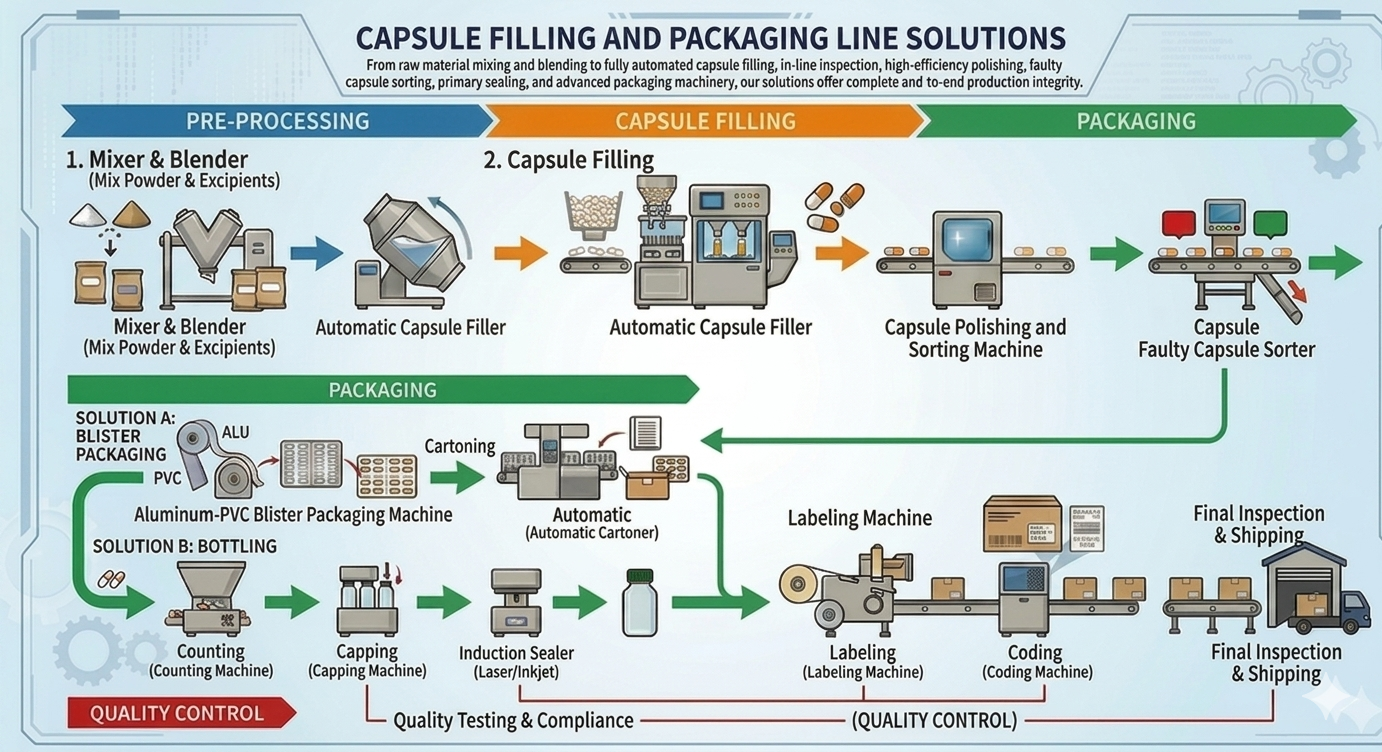
- Pre-processing Stage
This stage focuses on preparing raw materials to ensure a homogeneous mixture, which is critical for dose uniformity.
Essential Equipment:
Mixer & Blender: Typically a V-Mixer or 3D Mixer used to combine active pharmaceutical ingredients (APIs) with excipients.
Key Considerations:
Homogeneity: Ensure the mixing time and speed are optimized to prevent segregation of powders.
Environment Control: Maintain strict humidity and temperature controls to prevent powder clumping or degradation.
Material Grading: Ensure the particle size distribution is consistent to facilitate smooth flow during the filling process. - Capsule Filling Stage
This is the core of the production line where the precise dosing and assembly of the capsules occur.
Essential Equipment:
Automatic Capsule Filler: High-speed capsule filling machines (such as the ACF series) that handle capsule separation, powder/pellet filling, and locking.
Capsule Polishing & Sorting Machine: Removes excess dust and identifies empty or damaged shells.
Faulty Capsule Sorter: Automatically rejects capsules that do not meet weight or integrity standards.
Key Considerations:
Precision: Regularly calibrate the dosing disk or tamping pins to ensure accurate fill weights.
Dust Management: Utilize integrated dust collectors to maintain a clean environment and prevent cross-contamination.
Tooling Compatibility: Ensure the machine molds (change parts) match the specific capsule size (e.g., #00, #0, #1, #2) being produced. - Packaging Stage
The final stage transforms the loose capsules into a retail-ready product while ensuring long-term stability and protection.
Essential Equipment:
Blister Packaging Machine: For Aluminum-PVC or Aluminum-Aluminum strip packaging.
Bottling Line: Includes counting machines, capping machines, and induction sealers.
Automatic Cartoner: Folds leaflets and inserts blister packs or bottles into paper boxes.
Labeling & Coding Machine: Applies labels and prints essential data like batch numbers and expiry dates.
Key Considerations:
Seal Integrity: For blister packs and bottles, the thermal or induction seal must be airtight to protect against moisture.
Line Synchronization: The speed of the packaging machines must be synchronized with the output of the filling machine to avoid bottlenecks.
Verification: Implement vision inspection systems or checkweighers to verify that every carton contains the correct quantity and required documentation.